By Kirsten Larvick
Illustrating the complexities of interpersonal relationships within a family when you’re a part of the inner circle takes a certain amount of gumption, especially when you are the last woman standing in a patriarchal household of a father and two brothers. Maxi Cohen is that woman and also the filmmaker of this personal verité piece, Joe and Maxi (1978). Made in collaboration with co-director and cinematographer Joel Gold, the film documents Cohen’s efforts to deepen her relationship with her father, Joe Cohen, following the death of her mother.
The first five minutes of Joe and Maxi perfectly sets the stage for the journey which commences. A brief history is covered as well as an introduction to each subject, including cinematographer, Gold, who never appears on camera but is a key character in the story, as is his camera.
Throughout this uniquely observational film for its time, the camera follows Cohen as she routinely attempts to communicate with her father. Joe Cohen is uncomfortable expressing parental affection but doesn’t pull any punches when the subject of his daughter’s lifestyle and choices arise.

It’s clear that Cohen has made an alternative existence for herself and sharp familial generational differences are reawakened through the making of this film. The other women, close but extended family, seem far more sympathetic to Cohen’s desire to make art and explore a nontraditional role for herself. Cohen’s father disapproves of many aspects of her life, not the least of which is her filmmaking.
Still, despite his gripes, Joe Cohen enjoys the camera and takes delight in performing, proclaiming thoughts on women’s responsibilities among other topics. Like their relationship, the filmmaking becomes a sort of tug-of-war between Joe and Maxi. Cohen in her need to understand an emotionally remote father withstands harsh criticisms. Though Joe Cohen’s conversation is often peppered with sarcastic humor, restlessness, impatience and occasional anger, he seems to yearn for a connection too, and continues to participate in the filming. Herein lies the conflict which makes Joe & Maxi so compelling and also heartbreaking. Joe Cohen isn’t an easy egg to crack and his daughter wants so badly to form a more meaningful bond.
Not long after Cohen starts this process, she learns her father is seriously ill. The threat of losing another parent (while raising concerns about her own mortality) heightens Cohen’s need to connect and puts into question whether or not she should continue filming.
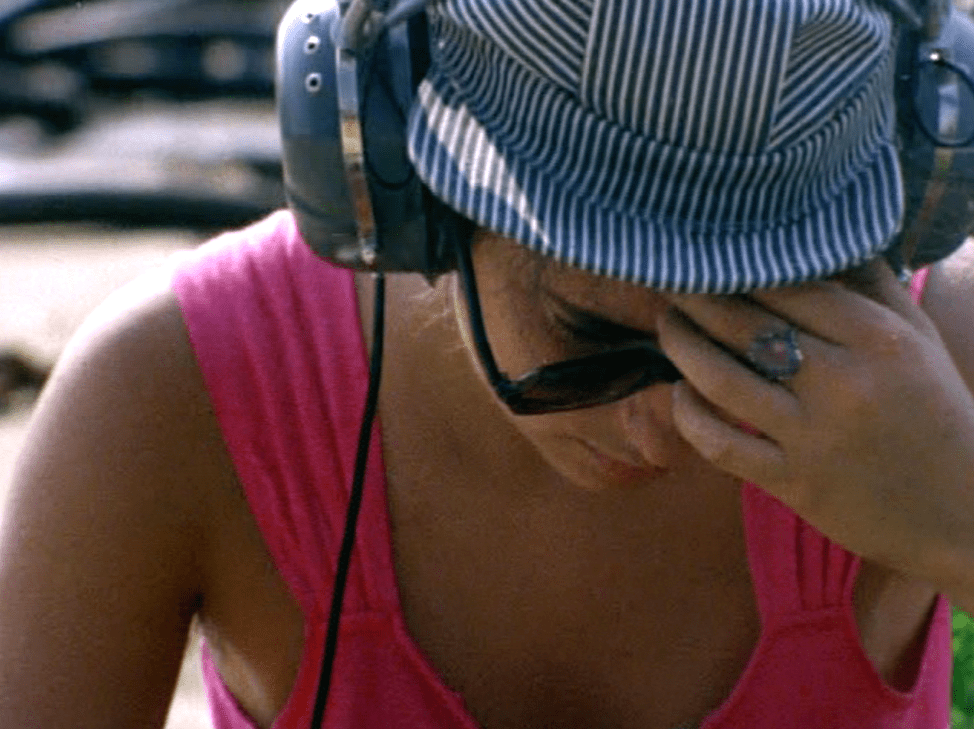
The aesthetic of verité storytelling provides an intimacy where a range of emotions confront the viewers. Allowing the camera to capture individuals in quiet moments reveals how body language, faces, eye contact or lack of eye contact can be more telling than the spoken word. Heated conversation and active scenes are present too, but Cohen finds a poetic balance. Joe and Maxi is a father-daughter story, that considers male/female relationships within a family and how those early, defined roles seek to resolve themselves as girls become independent thinking women.

While Liane Brandon’s satirical exploration of gender roles uses a starkly different process of storytelling, it is just as powerful. In Anything You Want to Be (1971) Brandon worked with public school teens to demonstrate the contradictory views of women put forth by family and society they were already experiencing.
This hybrid documentary which collages narration with vignettes by the students depicting their real-life stories, along with examples of corporate advertising, uncovers the unrelenting mixed messages imposed on women with clever and effective dry wit. Why is the subject of gender stereotypes funny? The conflicting ideas around what it is to be a woman are just as absurd as they are painfully true. Brandon knows how to sock us with a social issue while offering entertainment — a valuable educational tool.
Anything You Want to Be ingeniously depicts how difficult it is for young women to achieve their dreams against the odds. The illusion that all is possible is demonstrated to be just as damaging to one’s sense of self as the unpleasant truth, if the reality is very different.

Used for consciousness-raising, the film was a first in exploring these issues. It was a groundbreaking work of the Women’s Movement, because these questions were largely unexplored at the time.
Joe & Maxi and Anything You Want to Be will screen at UnionDocs this Sunday, May 20th at 7:30pm as part of the series From the Vault: Women’s Advocacy on Film, a co-presentation of UnionDocs and Women’s Film Preservation Fund. All films in this series were preserved by the Women’s Film Preservation Fund. Maxi Cohen will join the post screening panel in person along with Liane Brandon by Skype. The discussion will be moderated by media critic and historian Deirdre Boyle.
Tickets: https://uniondocs.org/event/2018-05-20-reexamine-reclaim-redefine-joe-and-maxi/
womens film preservation fund

Related Posts
Meet the New NYWIFT Member: Kaitlyn Diehl
Welcome to NYWIFT, Kaitlyn Diehl! Kaitlyn is an actor, producer, and screenwriter based between Philadelphia and NYC. She has starred in 25+ shorts, features, web series, and commercials in lead and supporting roles. Her first foray into filmmaking began when she co-wrote, co-produced, and co-starred in a short film with her sister, Jackie Diehl, titled Willow. The short was accepted into 13 festivals up and down the East Coast and won Audience Choice at the Media Film Festival. Inspired by the positive reception of Willow, Kaitlyn has since produced another short, Stand Up, and her first feature film, TINO. Both began their film festival circuits this spring. Kaitlyn continues to write and is currently in pre-production for a few exciting film projects. Stay tuned!
READ MOREMeet the New NYWIFT Member: Persia White
Welcome to NYWIFT, Persia White! Persia White is an actor, director, writer, visual artist, musician, and activist best known for her lead roles on Girlfriends and The Vampire Diaries. A passionate filmmaker, she co-produced the award-winning documentary Earthlings, narrated by Joaquin Phoenix. Her directing work includes acclaimed music videos such as Vampire, NOLA, and Robot Love, earning international festival recognition. She has also produced and co-written award-winning short films for Russell Simmons and Ovation. Persia co-founded Morgan White Productions with Joseph Morgan, and in 2026, Persia is launching Always and Forever, a nonprofit dedicated to supporting diversity and amplifying female voices in film, TV, and the visual arts.
READ MOREMeet the New NYWIFT Member: Jaime Schwarz
Welcome to NYWIFT, Jaime Schwarz! Jaime Schwarz grew up in NJ, the daughter of a Korean immigrant mother and son of Holocaust- survivors, father. Jaime earned her BFA in Acting from PACE University in NYC, appearing Off- Broadway in The Doctor at the Park Avenue Armory and on TV in Difficult People (Hulu), Younger (Paramount+), Jane the Virgin (The CW), Sorry for Your Loss, and Elsbeth (CBS). She is the director, writer, and star of the short film The Sandwich Line, which premiered at the Oscar-qualifying Indy Shorts International Film Festival, and her other writing work has been published in Mixed Asian Media and JoySauce. She’s currently developing several projects and is repped by Gersh + MJ Management. In our interview, Jaime discussed her journey from acting to directing and shared her experience of working in TV.
READ MOREMeet the New NYWIFT Member: Esther Casas Roura
Welcome to NYWIFT, Esther Casas Roura! Esther is an award-winning filmmaker known for blending metaphorical storytelling with animation. Originally from Barcelona, Spain, she began her career as a molecular biologist before moving to New York and transitioning into filmmaking, focusing on animation while working across both commercial and narrative projects. She later founded Claymaniak Studios (now ECR Films) to create emotionally resonant films across stop-motion, traditional animation, and motion graphics. Her animated shorts—Check Date: An Underdog Love Story, Creamen, and FLOCKY—have screened internationally at over 150 film festivals. FLOCKY was recently shortlisted for the Goya Awards in Spain, has received 18 international awards, and has gained international recognition for its social impact. Esther is currently developing her fourth short, The Melody Within, and her first animated feature, TAO.
READ MORE
